
Track 2: Torn — Natalie Imbruglia
Algorithms loom large in our imagination. “Our” algorithm can feel like a mirror-image of our inner self (albeit a distorted one), a bit like the dæmons in Philip Pullman’s fantasy series His Dark Materials.
For much of 2024, my Spotify algorithm constantly autoplayed Chappell Roan’s song “Good Luck, Babe!”. I came to resent the algorithm for ruining a song that I would have otherwise enjoyed.
Meanwhile, a friend texted me that her algorithm was obsessed with Natalie Imbruglia’s “Torn.” Who doesn’t love the 90s?
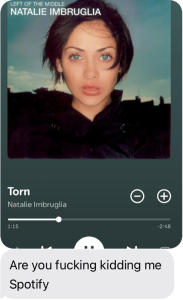
It’s not just me and my friend. Participants in an academic study also talk about the Spotify algorithm as if it was an entity of its own, towards which they have a range of feelings.
Exploring users’ algorithmic knowledge and reflexivity in a music streaming context: A critical realist approach.
Sebastian Cole, University of Oslo, Norway
“I don’t think that Spotify knows me very well.”
“For me, algorithms are supposed to help me, care for me, know me. That’s what they’re supposed to do [but they don’t]”
participants like Ingrid and William […] refer to Spotify as “a good friend”
“I know I am feeding the algorithm, and for me, it’s inevitable. […] just take my data. […] as long as you give me the music, I don’t really care.”
