
Track 4: With A Little Help From My Friends — The Beatles
In 1994, MIT student Upendra Shardanand submitted his master’s thesis. It described, by all accounts, the first algorithmic music recommendation system: Ringo.
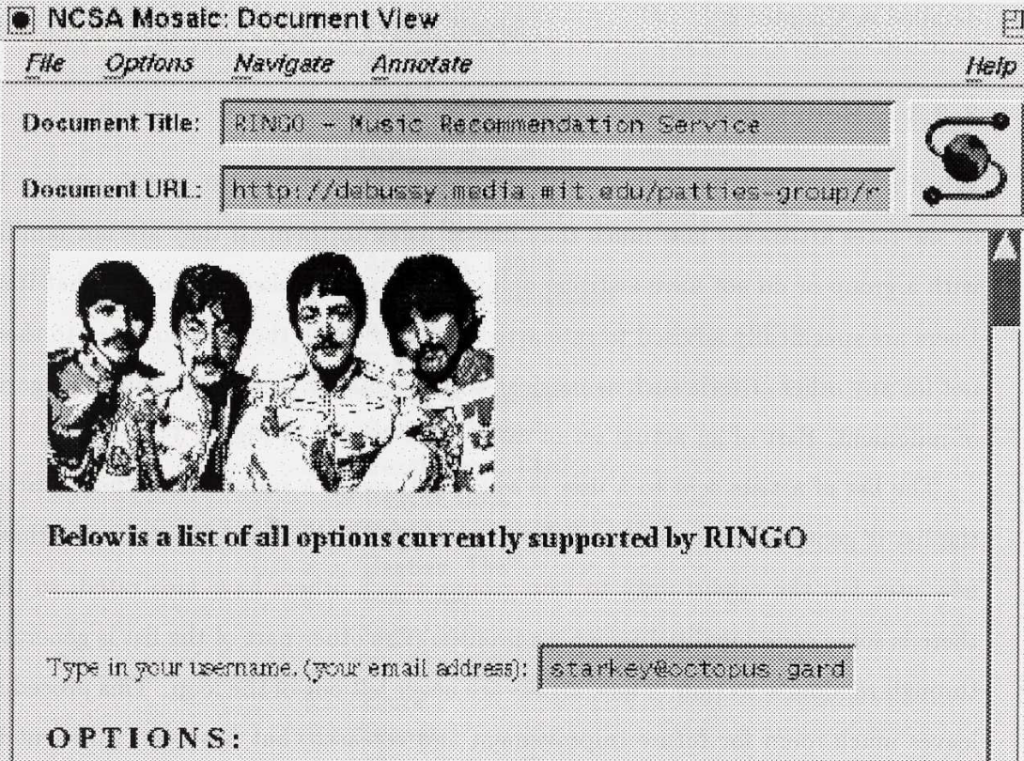
Users interacted with Ringo by email. After rating a list of artists on a scale of 1 (“Pass the earplugs”) to 7 (“BOOM! One of my FAVORITE few”), they received personalized recommendations, sometimes with reviews from others.
I’d rather dive into a pool of dull razor blades than listen to Yoko Ono sing. OK, I’m exaggerating. But her voice is *awful* She ought to put a band together with Linda McCartney. Two Beatles wives with little musical talent.
Never read the comments, even in 1994.
Anyway, what Ringo’s algorithm did was compare one person’s ratings with all of its other users. It then found people with neighbouring taste and recommended artists they liked. Engineers now call this “collaborative filtering.” For Shardanand, it automated word-of-mouth and was meant to be more serendipitous than “content-based filtering.” (Today’s algorithms mix both approaches.)
It’s interesting to see the actual math laid out in Shardanand’s thesis, especially now that corporate giants hide their algorithms as trade secrets. But I come to realize that “what is more important than the algorithms is the human element,” as he wrote.
Even back then, users viewed Ringo as a human-like entity, addressing it in natural language so much that researchers changed their boilerplate messages to be more impersonal. The thesis also anticipated the increasing role that artificial systems would play in our lives:
As long as people believe that an agent is a reflection of themselves, they will enjoy using the agent. Who doesn’t like looking in a mirror occasionally?
[H]ere is this system which operates 24 hours a day, […] grows, and in a way “learns.”
